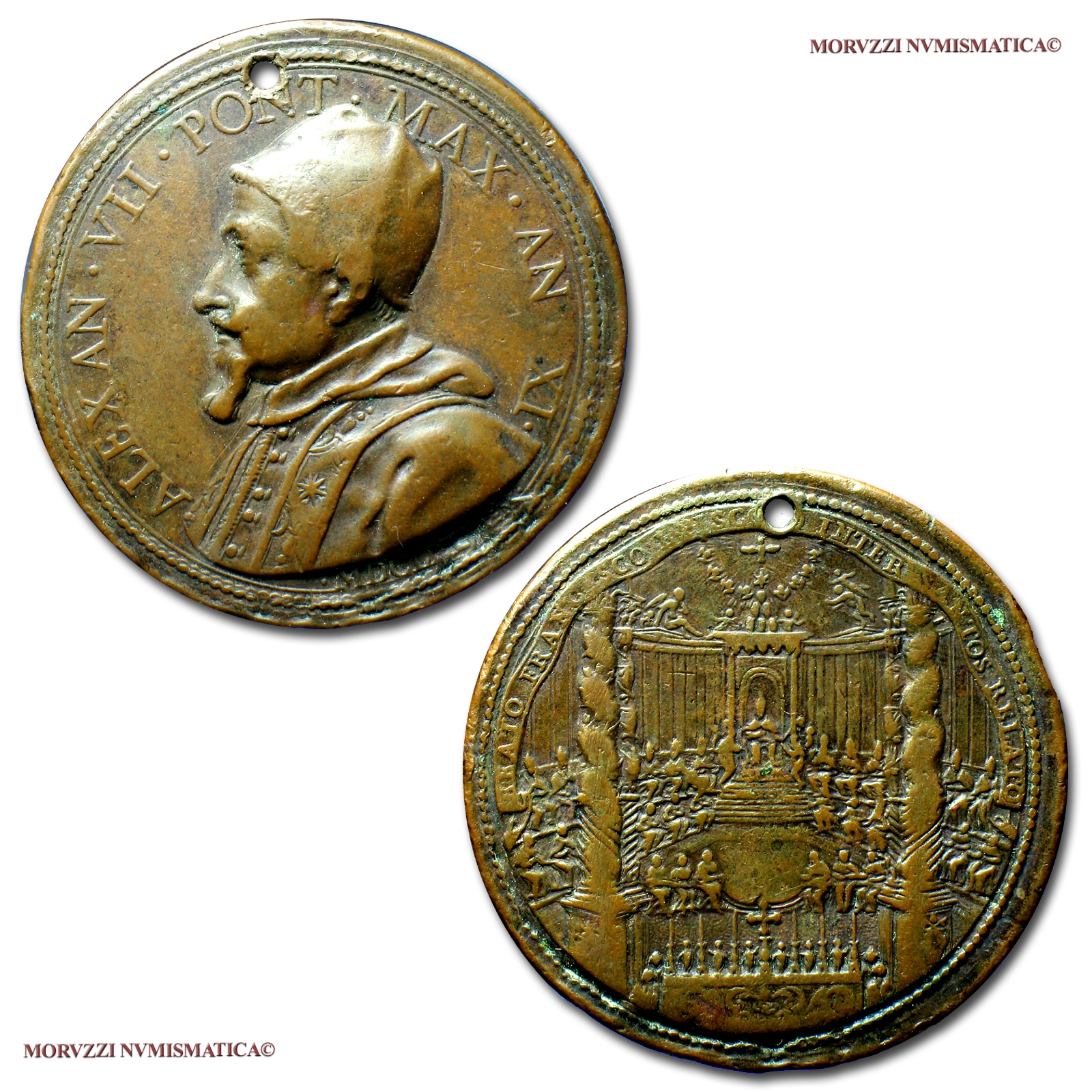
Canonizzazione di Francesco di Sales, Emissione: 1665 AN XI, Opus Gaspare Morone, Rif. bibl. Miselli, 626; Bart., E665a; Patrignani, XI / 1; Metallo: AE, gr. 27,69, (MP158186), Diam.: mm. 41,29, mSPL
Ex Astarte XXIII n. 653.
Stato Pontificio, ALESSANDRO VII, Chigi, 1655-1667, MEDAGLIA, Canonizzazione di Francesco di Sales, Emissione: 1665 AN XI, D/ ALEXAN • VII • PONT • MAX • AN • XI •, busto con camauro, mozzetta e stola a s.; sotto: • G M •, R/ BEATO FRANCISCO EPISCOPO INTER SANTOS RELATO, l'altare Maggiore di S. Pietro con il Papa in trono attorniato dai Cardinali, ai lati due colonne tortili, Opus Gaspare Morone, Rif. bibl. Miselli, 626; Bart., E665a; Patrignani, XI / 1; Metallo: AE, gr. 27,69, (MP158186), Diam.: mm. 41,29, mSPL
Contorno: perlinato.
Ex Astarte XXIII n. 653.
Medaglia annuale coniata, emessa il 29-06-1665 a ricordo della Canonizzazione di San Francesco di Sales (1567-1622).
In occasione della canonizzazione di Francesco di Sales, avvenuta il 19 Aprile 1665, si tenne nella basilica di S. Pietro una funzione particolarmente solenne, che ispirò l’incisore, Gaspare Morone Mola, per il soggetto di questa medaglia. Lo stesso Alessandro VII era molto devoto a questo Santo di cui custodiva con venerazione una reliquia donatagli dalla Regina di Francia, nel 1661. Francesco di Sales (1567-1622), nato da una famiglia savoiarda, nel 1599 sostenne l’esame canonico per l’episcopato alla presenza di Clemente VIII. Vescovo di Ginevra, fu poi a Parigi ove incontrò alcune grandi anime religiose in particolare frequentando il cenacolo di Madame Acarie, la futura Maria dell’Incarnazione, di cui divenne il confessore. Predicò alla presenza della corte ed al re Enrico IV oltre che in numerose chiese e monasteri. Impareggiabile maestro di spirito, figura eminente al tempo della restaurazione cattolica, nel 1604 incontrò la baronessa Giovanna Francesca Fremyot de Chantal (vedi E. 768), rimasta da breve tempo vedova, con la quale nel 1610 fondò l’Ordine della Visitazione. Le sue opere dottrinali, pietre miliari nella storia della spiritualità cristiana, servirono a riportare nel mondo di allora, sconvolto dalla rigida teologia calvinista, "la fede serena dell’essere figli e non schiavi di Dio".
Tutte le monete, medaglie e banconote vendute dalla Moruzzi Numismatica di Roma sono garantite autentiche senza limite di tempo e accompagnate dal “Cartellino” con QR code e dal “Certificato fotografico di Autenticità e Provenienza”.
One important aspect that determines the value of a coin is the correct grading of it. For this reason we study the techniques of production, carefully analyzing each exemplar by powerful lenses and microscope if necessary.
We use the European system of grading for our coins, ranging from VG (Very Good) to BU (Brilliant Uncirculated).
Shown below is the system adopted with a brief description for each grade.
VG Very Good · F Fine · VF Very Fine · EF Extremely Fine · BU Brilliant Uncirculated.
Proof isn't properly a grade but a special method of production. In the histogram present in the data sheet of each exemplar is graphically reported the level of the grade. It's adopted a grading in seventieths to help the Asian and American collectors accustomed to the Sheldon Grading System.
Another notable aspect in determining the value of a coin is the rarity. Coins have been produced in great quantity since ancient times and, being "industrial products", they're often common objects. But in many cases, this isn't true.
There are exemplars very difficult to find; in some cases, the rarity is subordinated to the big demand of collectors for certain symbolical issues (e.g. the coins of Julius Caesar). In the histogram, the level of rarity of the item is graphically reported in percentage, from a low percentage for very common coins (C) to 100% for extremely rare ones (RRRRR).
C Common · NC Not common · R Rare · RR Very rare · RRR Particularly rare · RRRR Extremely rare · RRRRR Of the greatest rarity.
Also the quality and the visual aspect of a coin's metal is a key factor in rating it. The metal of a coin can be damaged by the time goes on. Sometimes the defects can be caused by the low quality metal used during the minting process, or by an improper cleaning or a bad restoration.
Another aspect examined in this parameter is the patina, if present. With time, a thin layer can appear on the surface of a coin. An old collection patina can increase the charm of a coin and its value. The original old patinas attract the collectors. We remark the adjective original because in many cases the patinas are artificial. Artificial patinas or modern oxidations will result in a lower rating. Aggressive polishing can damage the metal of a coin causing a low rating.
For the ancient coins, the style of the coin dies used for the minting is really important.
Coins with a coarse style will receive a low rating in the histogram. Otherwise, coins with a fine style will receive a higher evaluation up to the maximum for the most artistic ones.
In the evaluation of the coins, especially the hammered ancient ones, it is very important to examine deeply the process of production and the materials used.
Exemplars minted in a large, not fractured flan and well centered will receive a high rating. Coins with high reliefs will receive a high evaluation reported in the histogram.
On the contrary, exemplars with damaged flan, not centered and with low reliefs will receive a lower rating. The same importance is reserved for the production with not worn out or not rusted coin dies.
Another significant element to take in consideration when determining the value of a coin is the provenance or pedigree, that is the certification of the various passages of the coin in the numismatic market and collections.
A coin with an old provenance, sold in prestigious auctions (Santamaria, Leu, Frank Sternberg et al.) or displayed in important collections (A. Moretti, A. Magnaguti, S. Pozzi etc.), will receive a higher percentage in the histogram than another one with a more recent or less prestigious pedigree.
All the coins offered by Moruzzi Numismatica have an absolutely legal provenance registered in the Italian authorities' lists.